
Technical guide
Double Triangular Covers and GRP Sealing Plates
Two hand-liftable castings in one frame, and a sealing plate beneath them. The format is regional, and the reasons for it are practical.
The format
Two triangles, one square opening
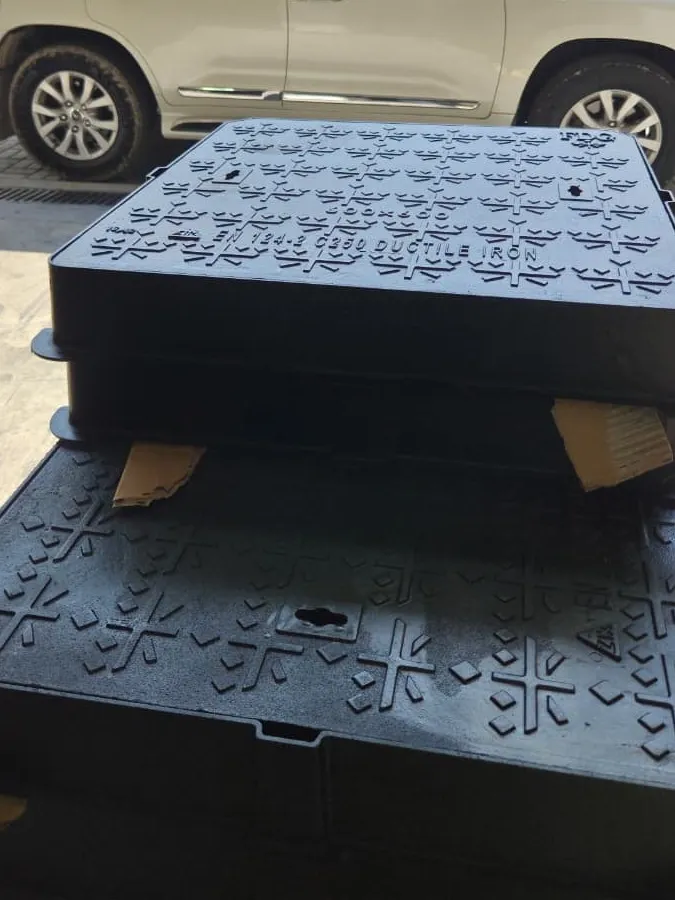
A double triangular cover closes a square clear opening with two triangular castings seated against a diagonal bearing bar in a single frame, and the geometry is the whole point. Each half is light enough to lift by hand, so the access point opens without lifting keys, plant or a second person.
The diagonal joint earns its keep on the way back down. The seating is self-centring — the halves find their position on reseating rather than needing to be worked into it — and under traffic the joint stays clamped instead of rocking. The halves are then bolted down with 2 × M12 × 60 bolts, nuts and washers.
That combination is aimed at how sewer access is actually used. A foul network is opened routinely — inspection, jetting, camera surveys — by crews working along a run, and a format a single operative can open, reseat correctly and bolt closed is worth more across thousands of access points than it is at any one of them.
The seal
Why the chamber is sealed at the cover
A cover and frame close an opening; they do not seal it. On a foul sewer in this climate, the difference matters at every access point.
Sewage generates hydrogen sulphide as it turns septic, and it turns septic faster the warmer it runs. At GCC ground temperatures that is not a fault condition — it is what the network does — and every access point that is not sealed becomes a vent for the street above it.
The regional answer is a GRP sealing plate: glass-reinforced plastic, light, and immune to the corrosion that same atmosphere works on metals. The iron cover carries the traffic; the plate seals the chamber against odour and water ingress.
On a schedule — and in our spec tables — this appears as “GRP provision”: a recess cast into the cover to take the plate. The provision travels with the casting, so a cover ordered with it is ready for a sealed chamber whether or not the plate goes in on day one.
The range
The published double triangular models
Dimensions and weights are read from the manufacturing drawings. All models are EN-GJS-500-7 ductile iron to EN 124-2, with GRP sealing plate provision.
| Model | Clear opening(mm) | Frame outer(mm) | Frame depth(mm) | Load class(EN 124) | Weight(kg) |
|---|---|---|---|---|---|
| 300×300 Double Triangle | 300 × 300 | 412 × 412 | 100 | B125 | 19.4 |
| 300×300 Double Triangle | 300 × 300 | 412 × 412 | 100 | D400 | 23 |
| 600×600 Double Triangle | 600 × 600 | 755 × 755 | 100 | D400 | 75.5 |
Seating clearance is 4 mm on the 300 × 300 and 3 mm on the 600 × 600. The weights are for the set as drawn, from the drawing title blocks. If the class is the open question, the guide to EN 124 load classes covers all six; if the dimensions are, the guide to clear opening and frame size explains which number is which.
Beyond the triangular
A sealed chamber does not force the format
GRP provision is not exclusive to the double triangular. Our recessed, solid top and round covers all carry it as an option, so a chamber that must be sealed can still take the format the surface demands — an infill tray in a paved plaza, a single-piece cover in a carriageway.
The double triangular is specified where the handling case wins: networks with many access points, opened often, by crews without lifting gear. That is a fair description of a GCC municipal sewer network, which is why the format is the standard sealed-access solution on the region's utility and sewerage networks rather than one option among several.
Common questions
Specifying sealed access
- What is a GRP sealing plate?
- A plate of glass-reinforced plastic that closes the chamber opening beneath the cover, sealing it against odour and water ingress. GRP is used because it is light and does not corrode in the atmosphere a foul sewer produces. On a schedule or a spec table, “GRP provision” means the cover is cast with a recess to take such a plate.
- Why two triangular covers instead of one square one?
- Each half is light enough to lift by hand, so an access point can be opened without lifting keys, plant or a second pair of hands. The two castings seat against a diagonal bearing bar: the joint is self-centring on reseating, and it stays clamped under traffic rather than rocking.
- Why is sealed access standard practice on GCC sewer networks?
- Sewage turns septic faster in heat, and septic sewage generates hydrogen sulphide — the gas behind sewer odour. At GCC ground temperatures that is the network’s normal operating condition rather than a fault, so every access point that is not sealed becomes a vent. Sealing at the cover is how the region’s utility networks keep the street side of the chamber closed.
- Do other cover formats take a sealing plate?
- Yes. Our recessed, solid top and round covers all carry GRP sealing plate provision as an option, so a sealed chamber does not force the double triangular format — it is chosen for its handling, not only for the seal.
- Which sizes and classes are published?
- A 300 × 300 clear opening in B125 and D400, and a 600 × 600 clear opening in D400, all in EN-GJS-500-7 ductile iron to EN 124-2. Other clear openings are produced to order — send the schedule with your enquiry.