
Technical guide
EN 124 Load Classes, A15 to F900
The class on a drainage schedule is a test load, not a traffic rating. Here is what each one means, and how the right one is chosen.
The basics
What the class actually is
EN 124 is the European standard for gully tops and manhole tops in vehicular and pedestrian areas. Part 1 sets the definitions, the classification and the test methods; Part 2 covers units made of cast iron, which includes the spheroidal graphite — ductile — iron these products are cast in.
The class is a test load. A unit is placed in a rig and loaded through a defined block until it reaches the figure its class names, and it passes if it does so without failing and without a permanent set greater than the standard allows. That is all the letter and number assert. The class is not a traffic rating, not an axle limit, and not a figure to design a pavement against.
The number is the load in kilonewtons, which makes the scale easy to read once you know it: A15 is 15 kN, C250 is 250 kN, F900 is 900 kN. The letter marks the installation group the class belongs to, and that group — not the number — is what a specification is really choosing.
Classification
Six classes, six installation groups
Test loads and groups are set by EN 124-1. The tonnes-force column is the common shorthand and is approximate — the kilonewton figure is the one the standard states.
| Class | Test load(kN) | Approx.(tonnes-force) | EN 124 group | Where it applies |
|---|---|---|---|---|
| A15 | 15 | 1.5 | 1 | Pedestrian and cycle areas |
| B125 | 125 | 12.5 | 2 | Footways, pedestrian areas, car parks |
| C250 | 250 | 25 | 3 | Kerbside channels |
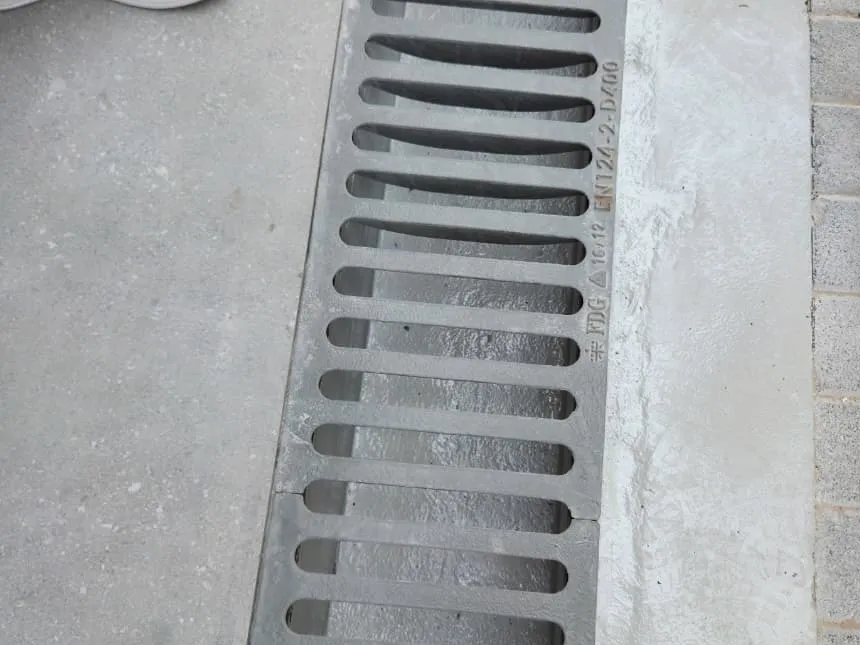
| D400 | 400 | 40 | 4 | Carriageways, hard shoulders, parking areas |
| E600 | 600 | 60 | 5 | Docks and other high wheel-load areas |
| F900 | 900 | 90 | 6 | Airport pavements and aprons |
Choosing
The class follows the location
A load class is a property of the place, not of the product. Establish where the unit sits and what crosses it, and the class follows. Two of the six carry almost all the traffic on a typical scheme, and the boundary between them is where schedules go wrong.
C250 is narrower than it is usually read. It is written for gully tops in the kerbside channel — a band reaching no more than 0.5 m into the carriageway measured from the kerb edge, and no more than 0.2 m into the footway. It is a class for the edge of the road, not the road.
D400 covers the carriageway itself, hard shoulders and parking areas, for all types of road vehicle. Once a unit sits in the running surface rather than the channel, D400 is the floor — and a C250 specified across a carriageway is the most common load-class error we see come through on drainage schedules.
Below those, B125 serves footways, pedestrian areas and car parks. The test is what actually drives over the unit rather than what the area is called: a car park crossed by refuse vehicles, delivery lorries or a fire tender is a D400 location whatever the sign at the entrance says. Above them,E600 andF900 belong to docks, industrial yards and aircraft pavements, where wheel loads leave the road-vehicle range entirely.
One thing the class is not is weight. Cover and frame are tested together, and rib design, frame depth and seating all contribute to the result — a heavier casting is not automatically a higher class. Specify by class; read the weight from the table for handling, lifting and freight.
In our range
Which classes we publish
Dimensions, frame depths and weights for every model below are published in full, measured from the manufacturing drawings.
Manhole covers
B125 · C250 · D400
Double triangular, recessed, solid top and round, from 300×300 through to 900×900.
See the range →Channel drains
D400 · F900
Channel gratings and cast channel to EN 1433, including an F900 channel for the heaviest duty.
See the range →Gratings
C250 · D400
Concave and flat gully gratings, edge grating and sewerage grating.
See the range →A15 and E600 are not part of the published range. Where a project calls for either, or for a clear opening outside the sizes listed, send us the schedule — units outside the standard range are produced to order.
Common questions
Specifying by load class
- Is the load class the maximum weight the cover can carry?
- No. It is a test load, applied statically through a defined block in a testing rig — not a traffic rating, not an axle limit, and not a figure to design against directly. A D400 unit is proved to 400 kN in the rig; the class tells you which installation group it may be used in, not how heavy a vehicle may sit on it.
- What load class do I need for a car park?
- B125 covers car parks and parking decks used by cars. The class follows the heaviest thing that actually crosses the unit, so where delivery lorries, refuse vehicles or fire tenders run over it — service yards, access lanes, loading bays — specify D400 instead.
- When is C250 correct rather than D400?
- C250 is written for gully tops in the kerbside channel: a band reaching no more than 0.5 m into the carriageway from the kerb edge and no more than 0.2 m into the footway. Outside that band, in the running carriageway, the class is D400. Specifying C250 across a carriageway is the most common load-class error we see on drainage schedules.
- Does a heavier cover mean a higher class?
- Not by itself. Class comes from the tested performance of the cover and frame together, and geometry, rib design, frame depth and seating all contribute. Weight is a consequence of the design, not the proof of it — always specify by class, and read the weight from the table for handling and freight.
- Which part of EN 124 applies to ductile iron?
- EN 124-1 sets the definitions, classification and test methods for all materials. EN 124-2 covers gully tops and manhole tops made of cast iron, which includes the spheroidal graphite (ductile) iron these products are cast in. A specification calling for ductile iron units to EN 124 is asking for Part 1 and Part 2 together.