
Technical guide
EN 1433 vs EN 124 for Channel Drainage
Linear drainage sits under a different standard from manhole covers — and which of the two applies depends on what is manufactured, not on where it ends up.
Two standards
Point access and linear drainage
EN 124 is the standard for gully tops and manhole tops — point access into a chamber below, where a cover and its frame are tested as a pair.
EN 1433 is the standard for drainage channels: linear systems in vehicular and pedestrian areas, where a channel body and its grating collect and carry water along a run rather than admitting access at a point.
The two share their classification. A15, B125, C250, D400, E600 and F900 mean the same test loads under EN 1433 as they do under EN 124, so a D400 channel and a D400 cover have both been proved to 400 kN. What differs is what was put in the rig — a cover and frame in one case, a length of channel and its grate in the other. If the class itself is the open question, the guide to EN 124 load classes covers all six.
Which applies
It follows what is manufactured
Our own channel range spans both standards, and the split is not arbitrary — it tracks what leaves the foundry.
| Our product | What is manufactured | Standard | Load class |
|---|---|---|---|
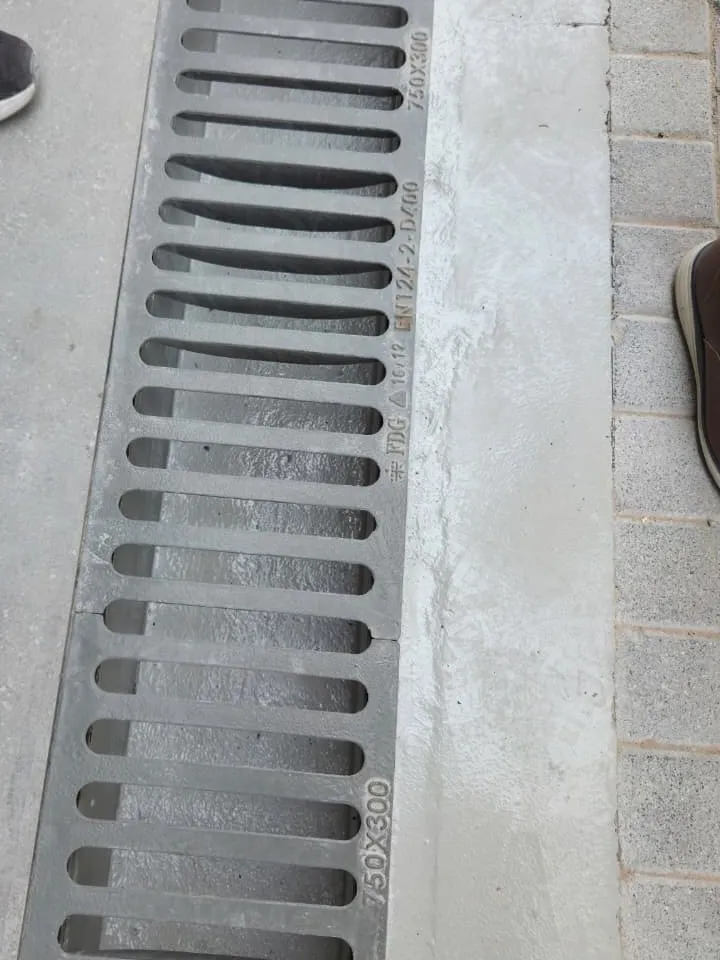
| Channel Gratings | Grating only, for a channel formed on site | EN 124-2 | D400 |
| Cast Channel | Channel body and grate, cast as one unit | EN 1433 | D400 |
| F900 Channel | Channel body and grate, cast as one unit | EN 1433 | F900 |
Where the channel is formed on site and only the grating is bought in, the grating is the manufactured product and EN 124-2 is the standard it is certified to. Our Channel Gratings carry the class cast into the face for exactly that reason — the certification travels with the part.
Where the channel body and grate are cast as a single unit, the drainage channel itself is the product, and EN 1433 applies. That is our Cast Channel and the F900 Channel.
This matters on a submittal. A consultant asking for “EN 1433 channel drainage” and receiving a grating certified to EN 124 has not been given the wrong product — but they have been given a different scope of certification, and it is worth saying so up front rather than at approval stage.
Hydraulics
Clear waterway is not the channel width
The nominal size is the outside of the unit. The waterway is what water actually passes through, and it is always less.
| Model | Nominal size(mm) | Clear waterway(mm) | Standard |
|---|---|---|---|
| 750 × 200 Reinforced | 750 × 200 | 140.5 | EN 124-2 |
| 750 × 250 Reinforced | 750 × 250 | 190 | EN 124-2 |
| 750 × 300 Reinforced | 750 × 300 | 240 | EN 124-2 |
| CHANNEL 150 | 1000 × 153 | 100 | EN 1433 |
| CHANNEL 200 | 1000 × 232 | 175 | EN 1433 |
| CHANNEL 300 | 1000 × 340 | 283 | EN 1433 |
A CHANNEL 300 measures 340 mm across the outside and gives a 283 mm waterway. A 750 × 300 grating gives 240 mm. Both are “300” channels in conversation, and they are 43 mm apart in the dimension that governs flow.
Size a run on the waterway figure, not the nominal. It is the same trap the covers have with clear opening against frame outer, and it catches people the same way — see the guide to clear opening and frame size.
The top of the range
What F900 looks like in the metal
F900 is the heaviest class in EN 1433: a 900 kN test load, against 400 kN for D400. It belongs in ports and dock aprons, airport pavements, and industrial yards where container handlers and loaded plant cross the run.
The jump is not a paper one. On our F900 channel the grate is held by eight M10 × 45 screws where the D400 uses four M8, the grate is 205 mm wide, and overall depth is 230 mm. Where a drawing does not dimension something — waterway and unit length on this model, at present — we publish it as unstated rather than assuming it matches the D400 channel of the same width.
Common questions
Specifying linear drainage
- What is the difference between EN 124 and EN 1433?
- EN 124 covers gully tops and manhole tops — point access into a chamber below. EN 1433 covers drainage channels: linear systems where the channel body and its grating work together to collect and carry water. Both use the same load class designations, so a D400 under either standard has been proved to the same 400 kN test load, but they are testing different things.
- Why are some of your channel products certified to EN 124 rather than EN 1433?
- Because of what is actually manufactured. Our Channel Gratings are supplied as gratings for a channel formed on site, so the grating is the product and EN 124-2 applies — the class is cast into the face. Our Cast Channel and F900 Channel are a channel body and grate cast as a single unit, so the drainage channel itself is the product and EN 1433 applies.
- Is clear waterway the same as the channel width?
- No, and the gap is significant for hydraulic calculations. A CHANNEL 300 is 340 mm across the nominal outside but gives a 283 mm clear waterway; a 750 × 300 grating gives 240 mm. Size the run on the clear waterway figure, which is the dimension water actually passes through, not on the nominal.
- When would a project need F900 rather than D400 channel?
- Where wheel loads leave the road-vehicle range: port and dock aprons, airport pavements, heavy industrial yards and container handling areas. F900 is proved to a 900 kN test load against 400 kN for D400, and the difference shows in the metal — the F900 grate is held by eight M10 × 45 screws where the D400 uses four M8.
- Do the units connect end to end?
- Yes. Cast Channel is supplied in 1000 mm units and the Channel Gratings in 750 mm units, laid end to end to make up the run length. Set out the run in whole units where the layout allows it, and tell us the total length with your enquiry rather than the unit count.