
Gratings
Concave Gully Gratings
Dished gratings that draw kerbside flow into the gully, in four sizes, all EN 124-2 C250.
Concave Gully Gratings
Ductile iron, EN 124 C250
A concave grating is dished rather than flat, so water running along a kerb or channel is funnelled towards the centre of the opening instead of spreading across the face. The result is a higher effective capture rate on the same clear opening, which is why concave tops are specified where flow arrives from one side rather than falling straight down. Supplied as a grating and frame assembly, cast to EN 124-2 C250 for kerbside and light traffic areas.
- Material
- Ductile iron EN-GJS-500-7 (GGG50)
- Standard
- EN 124-2 C250
- Format
- Concave (dished) grating seated in a square frame
- Finish
- Bitumen coated
- Tolerance
- ISO 2768-cL
Specifications
4 sizes, 1 load class
Dimensions in millimetres. Sizes outside this range are produced to order.
International range
| Reference | Clear opening(mm) | Frame outer(mm) | Frame depth(mm) | Load class(EN 124) | Weight(kg) | Drawing |
|---|---|---|---|---|---|---|
| FDGC-400 | 254 × 254 | 400 × 400 | 60 | C250 | 12.8 | 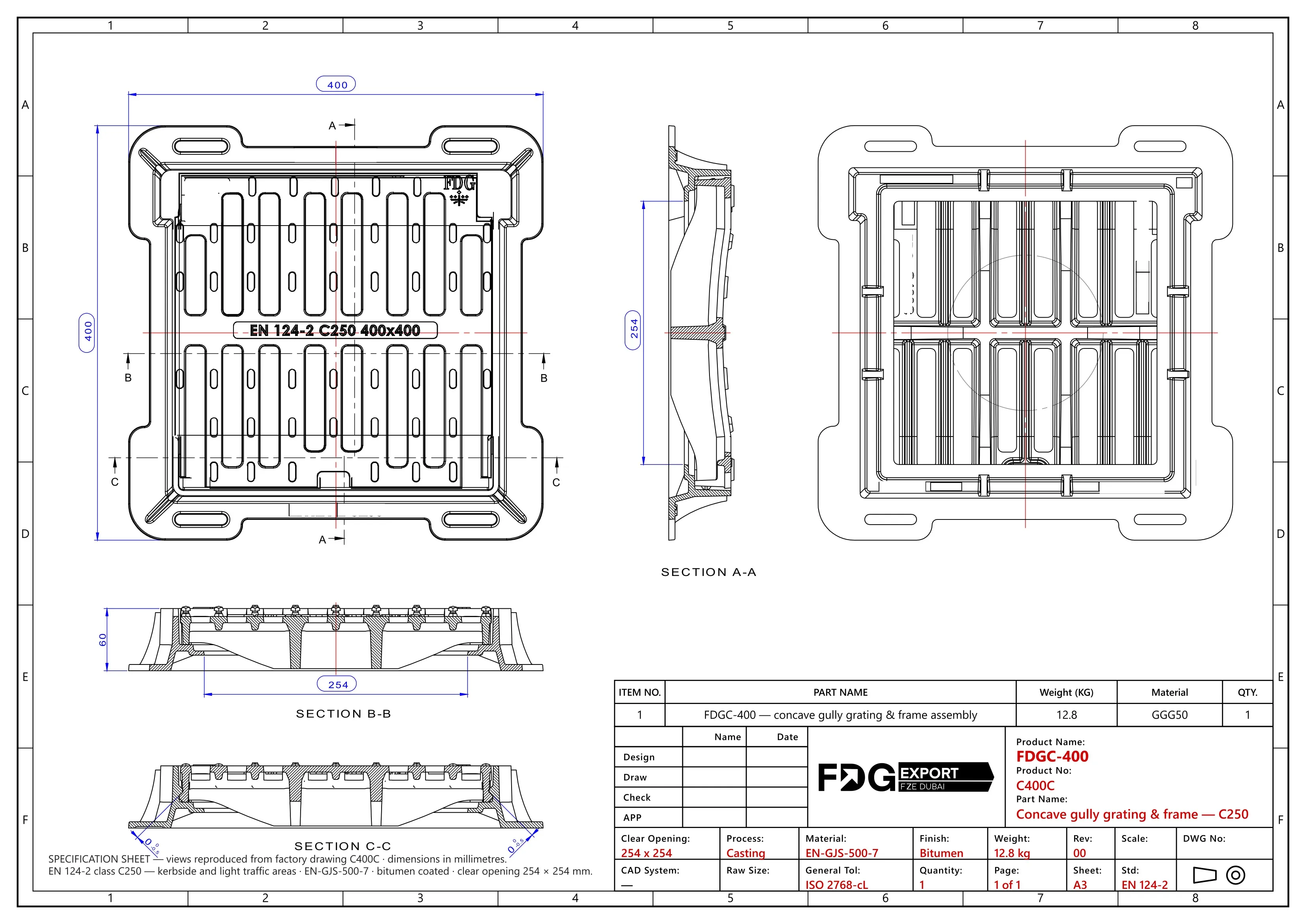 Preview only — contact us for the full drawing or DWG Preview only — contact us for the full drawing or DWG |
| FDGC-500 | 350 × 350 | 500 × 500 | 60 | C250 | 19.5 | 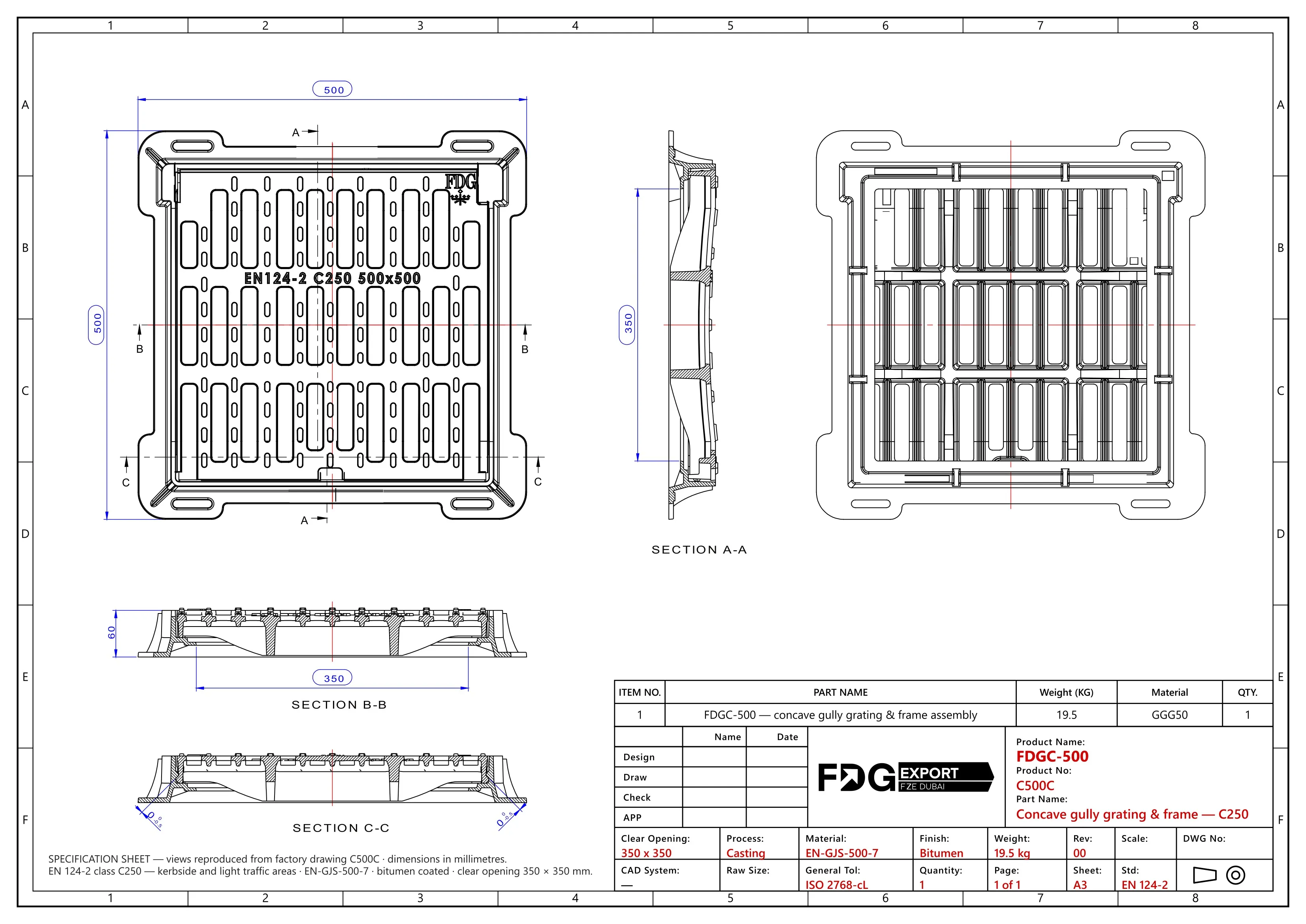 Preview only — contact us for the full drawing or DWG Preview only — contact us for the full drawing or DWG |
| FDGC-600 | 454 × 454 | 600 × 600 | 60 | C250 | 27 | 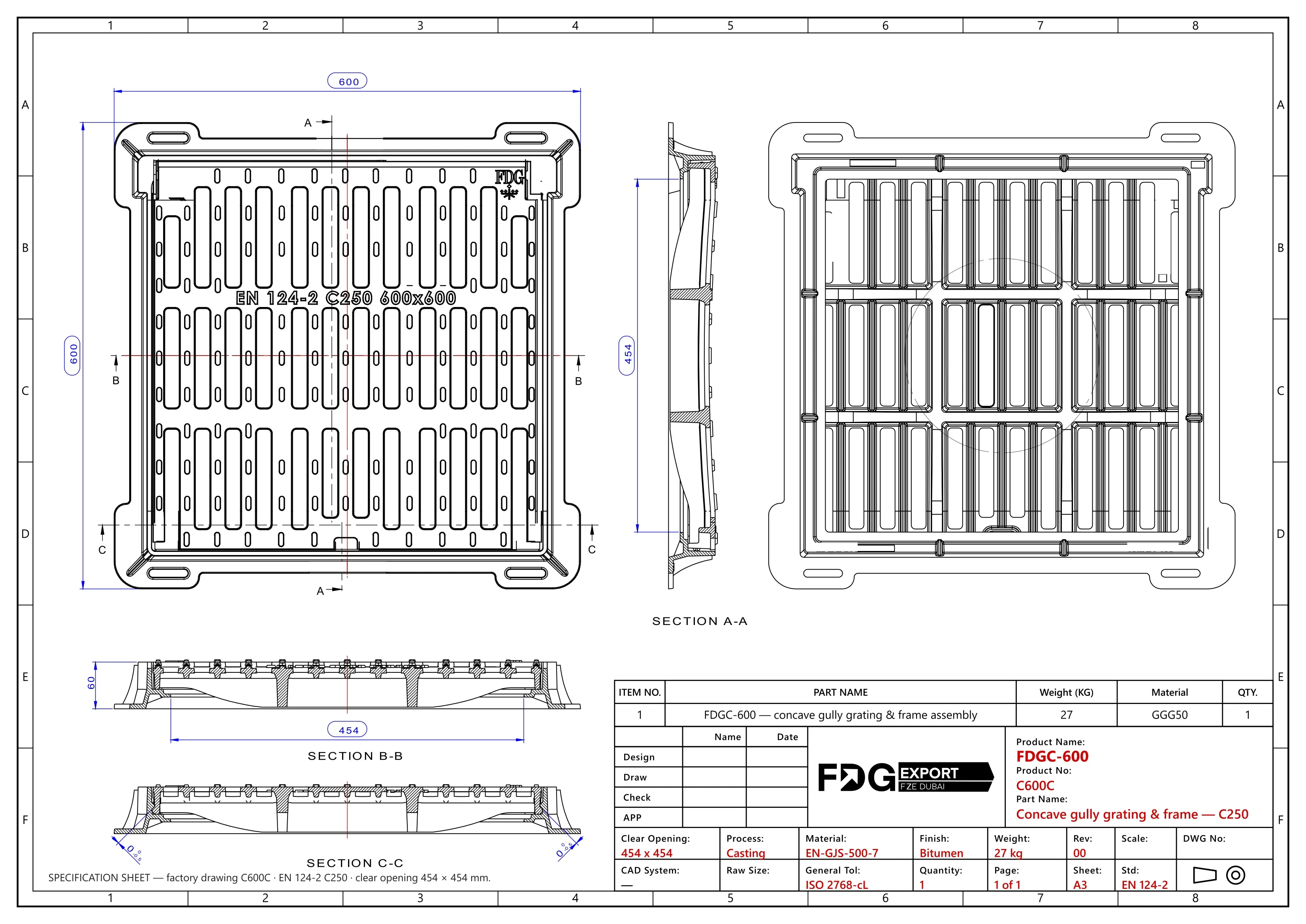 Preview only — contact us for the full drawing or DWG Preview only — contact us for the full drawing or DWG |
| FDGC-700 | 554 × 554 | 700 × 700 | 65 | C250 | 38.6 | 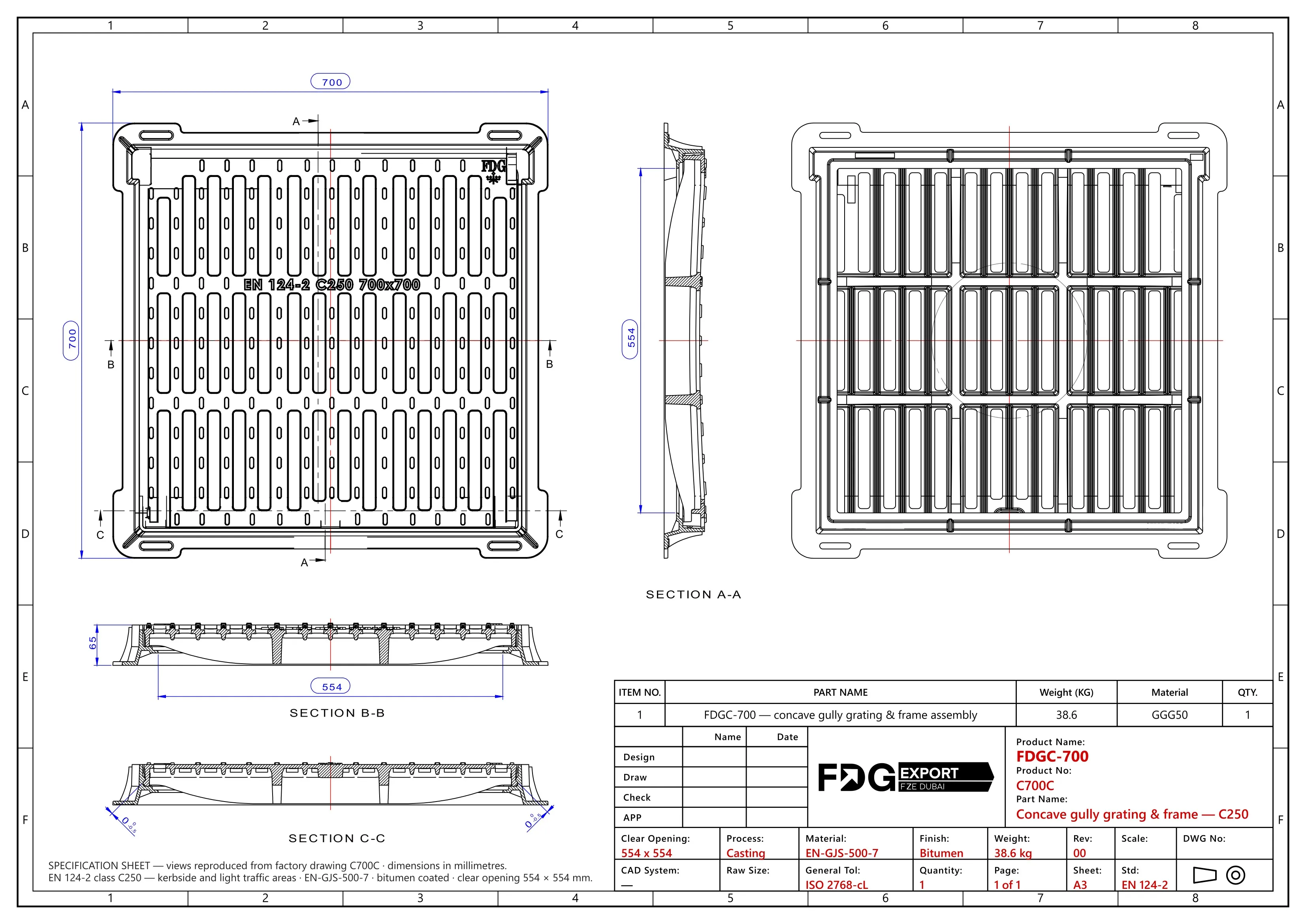 Preview only — contact us for the full drawing or DWG Preview only — contact us for the full drawing or DWG |
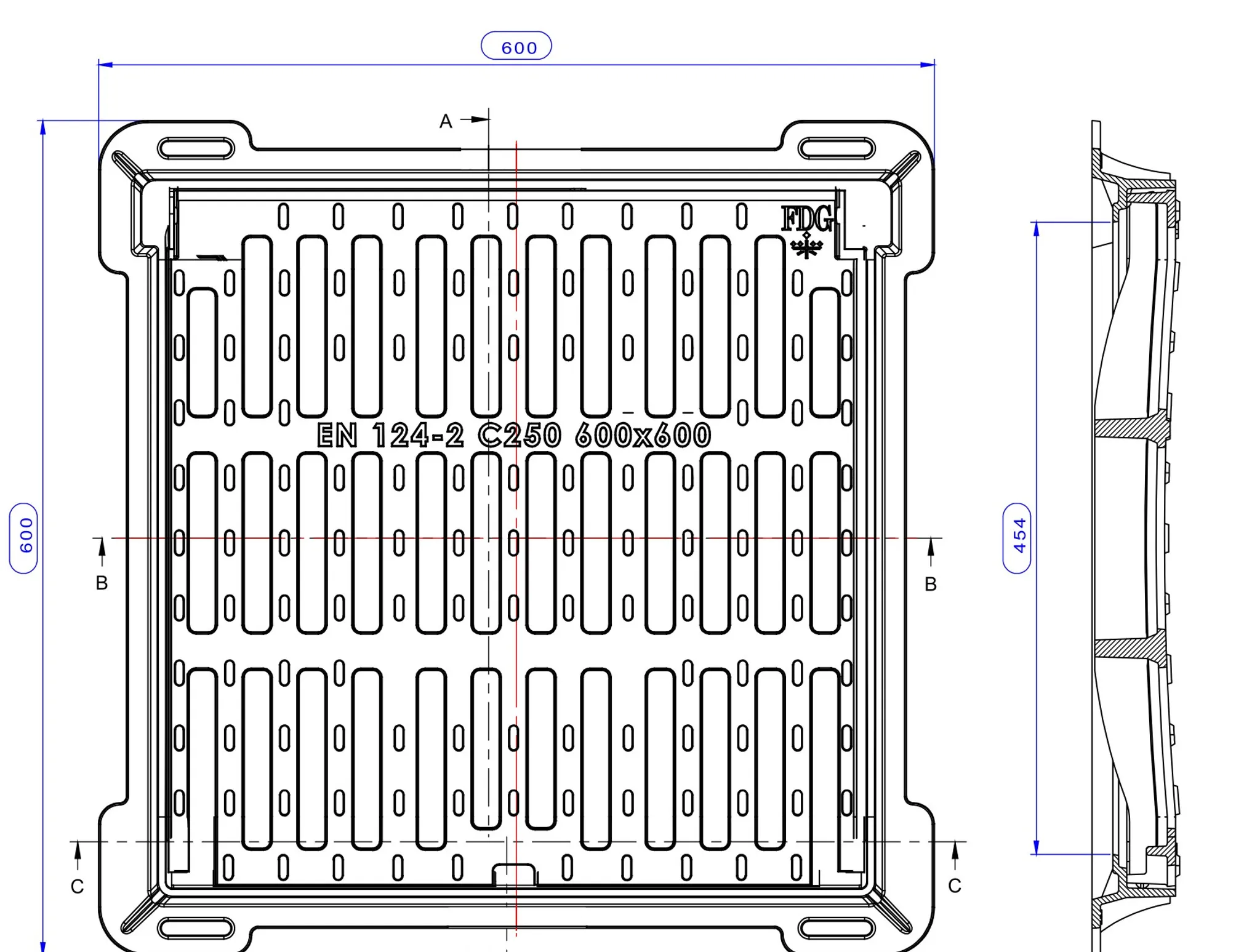
Four models to EN 124-2, grating and frame supplied as an assembly, EN-GJS-500-7 ductile iron, bitumen coated. Models are named for their nominal size and the frame outer given here is the measured plan dimension, which on this range matches the nominal exactly. Frame depth is the overall installed depth read from the section. Full drawings and DWG files are available on request.
Common questions
Specifying gratings
- When should I specify a concave grating instead of a flat one?
- Where the water arrives from the side rather than from directly above — along a kerb line, a crossfall or a channel. The dished face funnels that flow into the opening instead of letting it run across the grating and past it. Where flow falls straight down onto the grating, a flat top is the simpler choice.
- What load class are these?
- EN 124-2 C250 throughout, rated for a 25 tonne test load. That is the kerbside class, intended for the gutter area of a carriageway and for light traffic areas. Where the grating sits in the running surface of a road, specify the flat D400 range instead.
- Is the clear opening the same as the size in the model name?
- No. The model name is the nominal frame size — FDGC-400 is the 400 x 400 unit — and the clear opening is the aperture through the frame, which is 254 x 254 on that model. Both figures are published in the table so the chamber can be sized against the right one.
- Are the grating and frame supplied together?
- Yes. Each model is a grating and frame assembly, and the published weight is for the assembly rather than the grating alone.